Before Bangladesh Builds an AI Data Centre, It Needs to Fix Load Shedding
I was in the middle of training a model when the power went. Not the first time. A few weeks before that I was on a call with a client, mid-sentence, and the room went quiet and dark. If you work in tech in Bangladesh you know this rhythm. You save often, you keep the laptop charged, and you apologise to people in other time zones for something that isn’t your fault.
So when I read that there’s a proposal to build a two billion dollar AI data centre here, I should be the first person cheering. A project like this is supposed to be for people like me. Instead my first thought was that we can’t keep the lights on in the room I work in.
I want Bangladesh to build this eventually. I don’t think we should build it now, and I want to explain why in plain terms, because most of the coverage either celebrates the investment figure or argues about it in language that assumes you already work in this industry.
What is actually being proposed
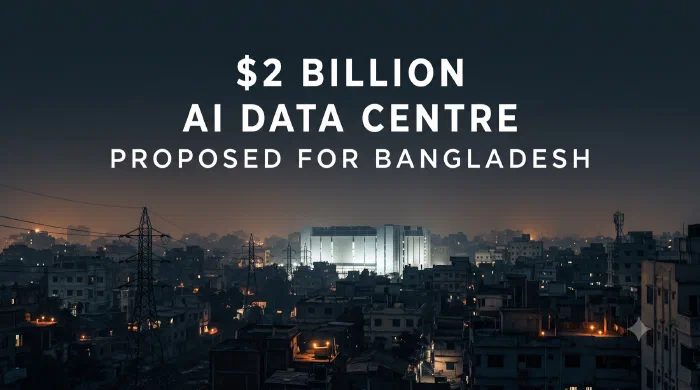
ADIC, a United Kingdom based firm, has sent the government a proposal to build an AI data centre at Kaliakair Hi-Tech Park in Gazipur or the Sirajganj Economic Zone[1] [3] . It went to the Prime Minister and the ICT ministry. The headline numbers: around two billion dollars in foreign direct investment, over ten thousand direct jobs and fifty thousand indirect ones, and a build-out in three phases. Phase one is 30 to 50 megawatts over two years. Phase two takes it to 100 to 200 megawatts. Phase three is described as long-term, quantum-ready expansion.
Part of the pitch is a Bengali large language model trained here, so the country isn’t dependent on models built elsewhere that treat Bangla as an afterthought. The proposal also asks for a 100 megawatt captive power plant with renewable integration, high-capacity water supplies, and multi-terabit submarine cable connectivity.
Those are real, specific asks, which is more than most investment announcements offer. Fahim Mashroor, the former BASIS president, has said the government should assess what already exists before committing to something new[1] , and that seems like the right instinct.
What an AI data centre actually is
Most people picture a warehouse full of computers storing files. That’s a regular data centre, and Bangladesh already has several.
An AI data centre doesn’t mainly store, it computes. Think of it less as a library and more as a factory, except the thing coming off the production line is invisible. When you type a question into an AI assistant, somewhere a few thousand processors work on it for a moment and send back an answer. Training a model is the same process running for weeks without stopping.
Everything it produces is weightless. Everything it consumes is not. That’s why a facility that makes nothing you can hold is still one of the most physically demanding buildings a country puts up.
The electricity question
Bangladesh has roughly 28,900 megawatts of installed generation capacity. That sounds like a lot next to 200. But installed capacity is a paper number. Around half of the country’s 143 power plants have been running below capacity because of fuel shortages, and the system loses somewhere between 2,000 and 3,000 megawatts to those shortages and to aging infrastructure. Peak demand sits around 18,000 to 18,500 megawatts. Rural areas have been going without power for seven to ten hours a day.
Now the 200 megawatt figure. Run continuously for a year, that’s about 1,750 gigawatt-hours. Bangladesh uses roughly 500 kilowatt-hours per person per year. Divide one by the other and you get around three and a half million people’s annual electricity, going to a single facility. The per-person figure moves depending on the source, but the order of magnitude holds. We’re discussing whether to commit the yearly electricity of a large city to one building, in a country already short by more than ten times that building’s demand.
To be fair, the proposal has an answer to this. It asks for a 100 megawatt captive power plant, which would mean the facility largely generates its own electricity rather than competing with households for what’s on the grid. That’s a serious answer and it deserves credit.
It also raises two questions. A captive plant still has to burn something, and Bangladesh imports something like 95 percent of its energy inputs, so the exposure to fuel prices doesn’t disappear, it just moves. And 100 megawatts of captive generation against a phase-two demand of 100 to 200 megawatts means the grid is still carrying part of the load, at exactly the scale the country is already short.
The water question
This is the part that gets left out of most of the excitement. Most of what follows I owe to an op-ed published at the end of July by Change Initiative, a Bangladeshi research organisation, which laid out the water case more carefully than anything else I’ve read on this.
Computers that work this hard get extremely hot, and if they aren’t cooled they slow down and then fail. A lot of large data centres cool themselves with water. A 2025 assessment put global data centre water consumption at around 140 billion litres in 2023, roughly 0.56 litres for every kilowatt-hour of electricity used. Apply that to a 100 megawatt facility running continuously and you get about 490 million litres a year.
And that’s only the water going into the building. Generating the electricity takes water at any thermal power plant, and so does manufacturing the chips, which is one of the more water-hungry industrial processes there is. The number on the water meter is the smallest part of the total.
Bangladesh sits in one of the largest river deltas on earth, so it feels odd to call it water-stressed. But the water isn’t where or when you need it. Groundwater under Dhaka has been falling by roughly two to three metres a year, and the Asian Development Bank expects that to reach five metres a year by 2030 if nothing changes. The rivers around the capital carry untreated sewage and industrial waste, enough that the World Bank approved financing in February to help clean them up. Coastal districts face salt pushing further inland, and the northwest has dry-season drought.
Who benefits, and when
Ten thousand direct jobs is the number in the proposal. I’d want to see it broken down. Data centres are not labour intensive once they’re running. The construction phase employs a lot of people for a while; the operating phase employs a much smaller number of specialists, permanently. Both matter, but they’re very different promises, and one figure covering both makes the permanent benefit look larger than it is.
Then there’s the question of who the computing serves. A facility like this can be genuine national infrastructure, with university researchers getting access and Bengali models actually trained on it. Or it can be a commercial site that happens to sit on Bangladeshi soil, selling capacity to whoever pays, with the Bengali model as the part of the pitch that gets built last. The difference isn’t in the technology. It’s in what the contract requires, and that gets decided before construction starts or not at all.
The case for building it
There’s real, documented demand. The Financial Express has reported that Bangladesh’s financial sector alone will need around 100 megawatts of computing capacity, while total domestic third-party capacity is expected to reach roughly 30 megawatts by 2026[2] . That’s a 70 megawatt gap in one sector. More than 5,200 crore taka has already gone into data centres here, about half of it foreign money, and the domestic market has been growing around 30 percent a year.
The connectivity side is genuinely ready. 5G went live in September 2025, the SEA-ME-WE6 submarine cable arriving this year brings serious international bandwidth, and there’s a draft National AI Policy.
The sovereignty argument isn’t sentimental either. If every model that understands Bangla runs on somebody else’s hardware in somebody else’s country, that’s a dependency with consequences, and the people arguing for building here are right about that.
What I’d want to see first
Fix the electricity, and not just for the data centre. A grid that can’t keep a household fan running through the evening isn’t going to support a facility needing perfect power for twenty years, and solving it for one industrial customer while everyone else keeps load shedding would be a strange set of priorities.
Publish the water rules before anyone breaks ground. No drinking-quality municipal water for routine cooling in stressed areas, closed-loop or liquid cooling required rather than encouraged, and licensing based on dry-season availability. Published in advance, so investors know what they’re agreeing to and citizens know what’s been agreed.
Use what already exists. Mashroor’s point stands. There are data centres in this country and a National Data Centre meant to host computing capacity. Find out how much of it is actually being used before building something an order of magnitude larger.
Build people before buildings. The specialists who run a facility like this take years to train and the pipeline is thin. Start the universities and the apprenticeships now, so the staff exist when the capacity does.
And start smaller. A modest facility sited where reliable power genuinely exists, running and serving Bangladeshi researchers, would prove more than an ambitious flagship stalled halfway through phase one.
Concretely, that means a signed public power supply arrangement showing where the electricity comes from and what happens when the grid is short; a water plan naming the source, the dry-season volume and the cooling technology; a public record of what ADIC has built before and at what scale; a binding commitment on the Bengali model and research access with dates rather than intentions; and a jobs figure separated into construction and permanent roles. If those existed, I’d change my position. None of them are unreasonable to ask for, and all of them are cheaper to sort out now than after two billion dollars has been committed.
Sources
- “UK firm proposes $2bn investment in Bangladesh AI data centre plan”
- “Financing data centres in Bangladesh” — The Financial Express
- “Report on the proposal” — Jago News 24